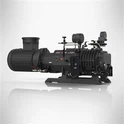
Hey there! As a supplier of Dry Screw Vacuum Pumps, I've been getting a lot of questions lately about how the number of screw threads affects the performance of these pumps. So, I thought I'd sit down and share some insights on this topic.
Let's start by understanding the basic working principle of dry screw vacuum pumps. These pumps use two or more inter - meshing screws that rotate in opposite directions. The rotation of the screws creates chambers that trap and transport gas from the inlet to the outlet, gradually reducing the pressure in the system to create a vacuum.
Flow Rate
One of the most significant performance factors affected by the number of screw threads is the flow rate. Generally, pumps with a larger number of screw threads can achieve a higher flow rate. Why is that? Well, more threads mean more chambers are created during the rotation of the screws. Each chamber can hold a certain amount of gas, and with more chambers, more gas can be transported in a single rotation.
For example, if you have a two - thread screw pump and a four - thread screw pump of the same size, the four - thread pump will typically have a higher flow rate. This is because it has more gas - holding chambers passing through the pumping cycle per unit time. If you're in an industrial process where you need to evacuate a large volume of gas quickly, a pump with more screw threads might be the way to go. You can check out our Oil Free Screw Vacuum Pump models, which come in different thread configurations to meet various flow - rate requirements.
Vacuum Level
On the other hand, the number of screw threads also has an impact on the ultimate vacuum level that the pump can achieve. A pump with fewer screw threads can often reach a higher vacuum level. The reason behind this is related to the leakage rate. With fewer threads, there are fewer contact points between the screws, which means less chance of gas leakage back into the inlet side.
When the gas is being pumped, any leakage can reduce the efficiency of the vacuum creation process. So, in applications where a very high vacuum level is required, like in some semiconductor manufacturing processes or high - end scientific research, a pump with a lower number of screw threads might be more suitable. Our Dry Vane Vacuum Pump series offers different thread options for users to choose from based on their vacuum - level needs.
Power Consumption
Power consumption is another aspect influenced by the number of screw threads. Pumps with more threads usually require more power to operate. This is because they have more surface area in contact between the screws, which leads to higher frictional forces. More power is needed to overcome these frictional forces and keep the screws rotating at the required speed.
If you're concerned about energy costs, especially if your pump will be running continuously, you might want to consider a pump with a fewer number of threads. However, you also need to balance this with your flow - rate and vacuum - level requirements. Our Water Cooled Vacuum Pump models are designed to optimize power consumption while still providing good performance, and we offer different thread configurations to give you more choices.
Noise and Vibration
The number of screw threads can also affect the noise and vibration levels of the pump. Pumps with more threads tend to produce more noise and vibration. This is because the increased number of contact points between the screws can cause more mechanical stress and uneven forces during rotation.
In an environment where noise and vibration are a concern, such as in a laboratory or a clean - room setting, a pump with fewer threads might be a better option. We understand the importance of a quiet and stable working environment, and we've designed our pumps to minimize noise and vibration as much as possible, regardless of the thread configuration.
Wear and Tear
From a maintenance perspective, the number of screw threads impacts the wear and tear of the pump. More threads mean more contact surfaces, which are subject to friction and wear over time. This can lead to a shorter lifespan of the pump components if not properly maintained.
Regular maintenance, such as lubrication (for pumps that allow it) and inspection of the screw surfaces, is crucial. However, if you want to reduce the frequency of maintenance and replacement of parts, a pump with fewer threads might be a more cost - effective choice in the long run.
Application - Specific Considerations
Different applications have different requirements, and the choice of the number of screw threads should be based on these specific needs. For instance, in the food packaging industry, where a relatively high flow rate is needed to quickly evacuate air from packaging containers, a pump with more threads can be a good fit. But in the pharmaceutical industry, where a high - purity and high - vacuum environment is essential, a pump with fewer threads might be preferred.

As a supplier, we've seen firsthand how different thread configurations can make a big difference in the performance of our dry screw vacuum pumps. We've worked with a wide range of customers, from small - scale workshops to large - scale industrial plants, and we understand that each customer has unique needs.

If you're in the market for a dry screw vacuum pump and are still unsure about which number of screw threads is right for your application, don't hesitate to reach out to us. Our team of experts is always ready to help you analyze your requirements and recommend the best pump model for you. We can also provide detailed technical specifications and performance data to help you make an informed decision.
In conclusion, the number of screw threads in a dry screw vacuum pump has a profound effect on its performance, including flow rate, vacuum level, power consumption, noise and vibration, and wear and tear. By carefully considering your application requirements and the trade - offs between these factors, you can choose the pump that best suits your needs.
So, if you're interested in learning more about our dry screw vacuum pumps or want to start a purchase negotiation, just get in touch with us. We're looking forward to working with you to find the perfect vacuum - pumping solution for your business.
References
- "Vacuum Technology Handbook", John F. O'Hanlon, Wiley - Interscience.
- "Principles of Vacuum Physics", G. L. Weissler and R. W. Carlson, Academic Press.